I've just walked past the World Bank HQ here in Washington DC - and d'ya know what? Yep, it's got an ATM in the lobby........Well, it made me giggle.
Friday, June 16, 2006

Monday, June 12, 2006
I need a decent night's sleep!
A summer cold and unusually hot night time temperatures in this little corner of Buckinghamshire mean that I'm hot and grumpy this Monday morning.
Oh it's nice to be able to work in shorts and a t-shirt, but the temperature's already over 80 degrees in the office and in a country where air conditioning would be a total waste for around 11 months of the year, this heat makes it really hard to get any work done.
Still, I'm off to Baltimore and DC for most of this week - so our current UK weather is probably good preparation for my US trip.
That'll be a couple of days of contrast too. On Thursday I've got a day at a bottling plant where they're piloting a new multi-million $ SAP application to automate much of the process previously done manually. A day later, I've an appointment at NASA HQ to look at the whys and wherefores of the fire which kilked three astronnauts in a ground test back in 1967. Within two and a half years of the disaster, two of their colleagues landed on the moon with around the same computing power available as I have in my pocket calculator. How much more power do the guys have to hand at the bottling plant to make sure the right product gets in the right bottles and out the door?
Fiday night should see me partake in a most un-British passion of mine - taking in a baseball game.
I spent my 40th birthday watching the Yankees beat the Devil Rays down in Florida. For my second live dose of MLB, I'm planning to head to RFK to see the Yankees once more, this time against the Nationals.
It's just coincidence that I'll be seeing the Yankees again, as I've very much a fan of sports underdogs. So, as far as I'm concerned, I've got to be up for the home team.
Anyway, sweats now dripping off my nose, onto my keyboard....not an edifying sight!
Sunday, June 04, 2006
Not the Weakest Link

The blog has been just a bit on the quiet side in the last week or so - partly down to trying to get some work done, and partly down to limbering up for my first appearance on national TV - as a contestant on BBC's 'The Weakest Link'. I finally recorded my episode last Friday afternoon - though it was well into the evening before I eventually got away.
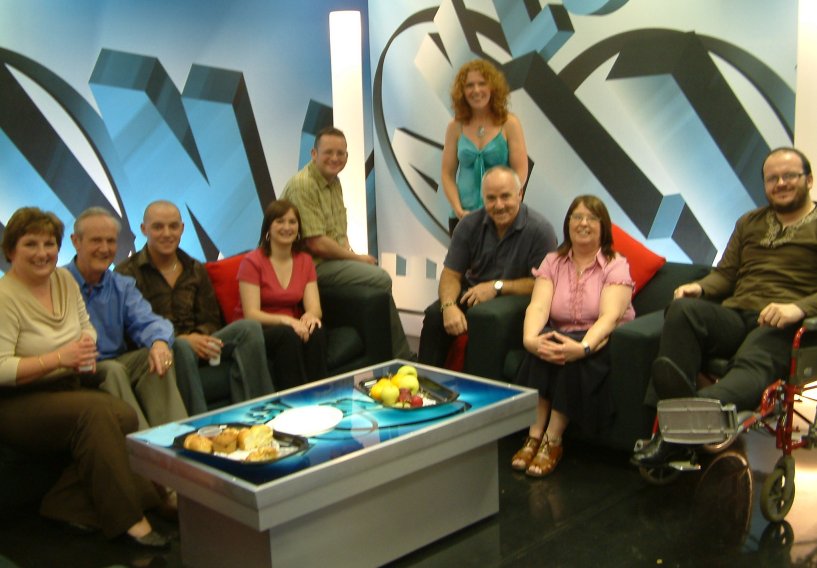
The show is recorded at Pinewood Studios - and it was a bit of a nostalgic trip back, as I often visited Pinewood in the years when my father in law worked there as a neg cutter.
But last Friday was my business and I rolled up to the gate at about 2.15pm with more than a few butterflies in my stomach.
I almost bumped into the show's host, Anne Robinson, as I arrived. She'd just finished one show, and was heading out for some air with her entourage. She doesn't really speak to contestants, so not a word passed between us - and I don't think there was even any eye contact.
The next few hours were what TV game show recording is all about - boredom. The crew records three shows a day and as I was to appear on show 866, they've clearly got things down to a very fine art.
We were coralled in the green room with coffees, teas and sarnies (I really couldn't touch any food), until the next show had moved from the holding room into the studio (as I arrived, the first set of contestants were still on their high in the green room having just completed their recording, and were about to leave.). As show 865 moved into the studio, we were taken to the holding room - a yellow-walled, institutional waiting room. Over the next couple of hours we had our show clothes chosen by a pair of wardrobe assistants; had our make-up applied to cover the ravages of time and fate, and drank more coffees and water - and made a few loo trips. I have to say that the secret of my day was a couple of immodium before even leaving for the studio. It works wonders, honest!
Ben the assistant producer took us through our biog details (which provide Anne Robinson with the ammunition for her banter), but most of the time it was sitting around, getting to know the other contestants a little, and chatting to Becca and Marco, two of the show's 20-something, trendy-in-a-BBC-sort-of-way researchers.
We were the usual spread of contestants - 18 - 66; five male four female and covering everything from a dinner lady to a wheelchair-bound Mormon priest....with, of course, the obligatory student.
Finally, at around 5pm, we moved to the 'pre titles room' - the one in the picture above. Here, more sandwiches awaited, plus a thorough briefing from Ben, before the first bit of filming - the pre-titles bit when the camera zooms in on the contestants as we sit around and chat on the BBC's new sofas.
Probably 45 minutes later we finally entered the studio. All draped in black (the studio, not the contestants), with no audience and a quietly expert crew, we were taken through a technical rehearsal: - "Don't talk until the red light over the camera flashes..." "I'm Mark, I'm 42, I live in Princes Risborough and I'm a communications consultant."
There's no rehearsal with Anne. She arrives on set at the start of the show and launches right into it. No introductions, witty banter or relaxing words. Nope, the ice maiden image is retained from first to last and her guard really doesn't drop.
So, for the next couple of hours we recorded the show. The rounds are recorded in real time, but the voting off process is a two-stage affair, and Anne disappears between rounds to get cues from the production team on who to go after in the next round.
It was a fascinating experience, and one I really enjoyed being a part of. So how did I do? Well, BBC contractual obligations mean I can't reveal the result - or how I personally got on - until the show first airs. That's likely to be sometime between mid-July and mid-August. So, until then, it's my little secret.
Wednesday, May 24, 2006
Interimitis
There's a trend in employee comms at the moment for interim managers - especially during 'change' (though isn't everything in business in constant flux now?).
It's something I was initially in favour of as I saw it as offering more opportunities, but I've now had my fingers burned and will tread very warily when anyone comes knocking looking for an interim.
For me, being on the inside of an organisation as an employee means knowing it inside out and getting all the benefits of being part of the business entity. The downside for communicators is being at best, a middle-management employee, so rarely having the clout to make a huge impact.
Working as a consultant makes it easier to have the challenging conversations with senior management, but you're never truly a part of the team. You're regarded as an outsider - and may be perceived as a threat.
The interim should be seen as an insider, but should also have the power and impact of a consultant. But my experience has been very different.
My experience is that:
- Businesses hire interims to do the jobs no-one internally will touch
- Hires are made at too high a level - but the work is often low-grade transactional
- Interims are regarded as employees rather than expert partners, and consequently are rarely used effectively as part of the business decision chain.
I know interim assignments work for a lot of people - at least at surface level. But I wonder how often the expectation meets the actuality for both the client and the interim.
Tuesday, May 23, 2006
Perception matters
Why, as employee communicators, do we act grateful when we're invited to the meetings where key decisions are made?
Surely we should be one of those 'functions' that are first on the list when change is afoot in any business. Legal are always there, and HR, Public Affairs and often even the Marketing guys - but employee comms tends to get invited in only after the event to package the outcomes, dice them nicely and make them palatable to internal stakeholders.
I think it's because we don't present ourselves as well as we could. We're happier in our comfort zone as expert writers and editors and thus engage with business leaders as useful transactional functionaries.
It's much harder to step out of that role and really present a challenge to management: to ask the awkward questions, and be a real pain in the arse.........all in the pursuit of overcoming business issues.
But Legal don't have that problem, or HR or even Marketing - never mind our external communication colleagues. CEO's tend not to feel they know better than these 'niche' experts - and will generally engage with them in a more adult:adult conversation.
It's time we grew up and really flexed our muscles a bit - and started asking 'why' a bit more about the issues we're asked to handle. Risky? Perhaps, but the only way to show the real benefit we can bring to a business.
Friday, May 19, 2006
Cast in another light
I was talking to a guy about podcasting the other day and he made the very astute point that the very name of this medium puts a lot of people off.
It hadn't struck me, but he argued that quite a lot of people thought podasting wasn't for them because they didn't have an i-pod.
Of course, podcasting has nothing much to do with i-pods other than the fact that an i-pod is one means of playing back the downloaded content. But you could be using any MP3 or 4 player, your PC or phone or whatever to the same effect.
So, should we be looking for another name for podcasting? It's not broadcast - in fact it's can be 1:1-cast.
Perhaps we should start talking about commscasting????
So thanks Adam from Vodafone for getting beginning to get my mind round that.
Thursday, May 18, 2006
Preaching to the converted
I ran an 'output to outcome' course yesterday with a group of communications managers - 7 IC managers and one PR.
It was focused on internal stakeholder communication and what was most apparent was that communicators want to make communication an enabler for delivering business strategy, but are stymied in so doing by:
It was focused on internal stakeholder communication and what was most apparent was that communicators want to make communication an enabler for delivering business strategy, but are stymied in so doing by:
- constantly being forced to react
- being pushed into the 'package and deliver' box
- being seen as the people who write and design stuff.
Most of our day was spent looking at how to get into the right conversations so that communication becomes part of the discussion that leads to a business decision rather than simplyt being the transactional packaging of that decision after the debate has concluded.
We also looked at the hoary old subjects of measuring value to the business and making communication a process to deliver business improvement rather than a series of events only sideways aligned to business goals.
My take-away on the day was: Don't talk about communication. Talk about solving business issues, and managers will be far more parepared to listen to you and work with you in the way you want to work.
Thursday, May 11, 2006
Revealing
Sometimes the simplest of tools are the most revealing.
I ran a training session with a bunch of HR consultants yesterday and included a chinese whipers exercise to simulate an organisational communication cascade.
The construct was a series of four connected statements - with one slightly spurious one attached which had to be relayed through a chain of seven people.
Two groups competed against each other - with the added distraction of me telling very bad jokes to put them off.
The final scribes each noted one statement. Each noted a different statement and neither was actually quite true to the source document.
It certainly caused some pause for thought among the participants. Just how effective are traditional cascades - and how effective is verbal communication, especially in business environment of BAU?
Tuesday, May 09, 2006
Both sides of the coin
I tend to stick up for the strategists in organisational communication: no matter how good the media, it's useless if it doesn't derive from the right plan to create the right outcome.
So I sometimes get it right back in the neck - 'without the outputs, plans are useless'.
And of course it's absolutely true. Communication is only ever going to be effective if we have both the ying and the yang - great planning and great execution.
Thankfully, I still get involved in both, and was quite excited to receive my copies of law firm CMS Cameron McKenna's Solve. This is the firm's client publication - designed to be an awareness-raising light read aimed at current and prospective clients. It's just one part of a well-designed marcoms mix, and also plays well internally with the partners and staff.
I hadn't written a publication for a law firm before, but the client was able to give me a clear brief and strong context of what their business objectives are; how marketing was helping to deliver these goals and the niche where this publication fitted in. Essentially, their culture is about building relationships, and Solve helps reveal the human side of the firm and the law it deals with.
They're very pleased with the result - and so am I - a tactical tool that I think is well executed.
Thursday, May 04, 2006
Serendipity
It's funny how two seemingly disparate pieces of work can fuse together quite powerfully.
At present I'm putting together a training day on the move from an internal communications focus on outputs - those award-winning magazines, events and intranets - to outcomes - what business benefit is the communication actually enabling?
I'm also researching an article on the 40th anniversary of the Apollo 1 cockpit fire that caused the deaths of Gus Grissom, Roger Chaffee and Ed White.
I'd been looking for a powerful motif of outcome-based communication to set the tone for the training day. I found it on page 1 of Andrew Chaikin's book: A man on the moon.
Chaikin quotes John Kennedy, standing on the podium at Rice University Texas on September 12 1962. Kennedy said: "I believe this nation should commit itself, before the decade is out, to landing a man on the moon and returning him safely to the earth."
Whatever political and cold war sentiments charged that statement, it gave an entirely clear direction that steered the efforts of 400,000 people for the next seven years. When Neil Armstong set foot on the moon, the outcome was achieved.
Millions of messages were exchanged at thousands of levels between September 1962 and July 1969 when Apollo 11 achieved Kennedy's avowed intent. But having that clarity of purpose articulated clearly ensured everyone was engaged in reaching a clear goal. Few events, before or since, have enjoyed such clarity of purpose - but what an example of what can be achieved.
Subscribe to:
Posts (Atom)

 Posts

