Last week I read a request for help on LinkedIn that so vexed me that I’m still thinking about it a week on.
A member of an IC interest group wrote: “I’m struggling to engage a specific group of employees who are reluctant to embrace social media any suggestions on some new innovative ways?”
My response was: “Do they have to embrace social media? It would seem that whatever the question is for IC pros at the moment, the answer is ‘social media’. Sometimes, in its many and various forms, it is the answer – but not always.
"We seem to be losing the art of face to face communication and the appetite for traditional comms. In the rush to embrace the electronically-driven social world, that could be a very costly error. Have you talked to this group? What’s their take on comms? Are there channels and media that they appreciate and respect? What’s worked for them in the past – do you know the reasons why they’re not embracing social media?”
“Without knowing that side of the story, it’s tricky to suggest a way forward. But, the newest, sexiest, shiniest forms of comms aren’t always the best for any particular group, and the worst mistake we can make is to impose what we like onto a group with a different (and perhaps just as valuable) perspective.”
The debate has gathered almost two dozen comments, with a group suggesting various options to draw this non-specified audience into social media, while others have either supported me, or in the case of Jim Shaffer, moved the debate on a little. Jim’s point is that we shouldn’t be arguing about traditional v social, but, as he said: “The question and a lot of the responses here are about process versus results or outcomes. What results are you trying to change? What outcomes do you want from “embracing social media?” It would seem that if people 1) had access to a solution that would improve a business outcome, 2) if it was in their best interests to make the improvement and 3) it was their idea to adopt that solution, they would. Or that’s what usually happens. Asking people to embrace social media is like asking them to embrace posters.”
For me, Jim’s hit on an issue that’s worrying me more and more as I engage with comms pros here in the UK. There’s a distinct band-waggoning on social with the result that any discussion of strategy or tactics that doesn’t involve the latest application of digital wizardry is kicked out the door in double-quick fashion. There’s an assumption that social is some kind of magic bullet – and that the likes of Jim or me advocating an approach that looks at audience needs, business outcomes and the best way for comms to enable such an outcome must be something akin to walking with dinosaurs.
It’s worrying to me in that we seem to be knocking back a good decade of internal comms evolution – the decade that took us from output to outcome and brought leaders across organisations out from behind their emails. To me, there’s a real danger that too much emphasis on social will push our leaders back behind their electronic walls – while too much emphasis on social media will over-dignify the technology, while underplaying the need for solid comms that brings people together in the right way to achieve the right outcomes. Too many people are getting a little too excited about the outputs again – without considering if they’re achieving the right results.
There’s so much talk of social media democratising business – but do you know what? Businesses aren’t democracies. And unless the principles of capitalism are about to fail, they’re not about to become democracies. I am immensely in favour of social’s ability to enable collaboration; to break down the barriers of geography and time zones. But it’s not a panacea. Surely it will enhance our communication offering, not replace all that has gone before?
Not according to Gartner, apparently. Last Thursday I headed up to Milton Keynes to listen to the very excellent Rachel Miller talking about ‘putting the social into communications’. In a really informative and entertaining presentation, she raised many points I agree with – and a few I’d take issue with.
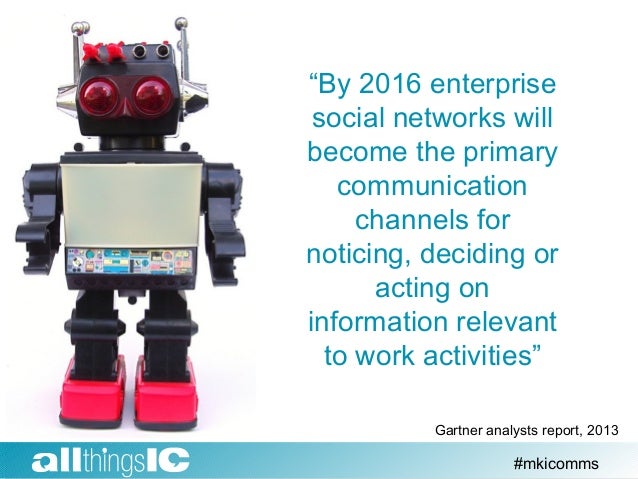
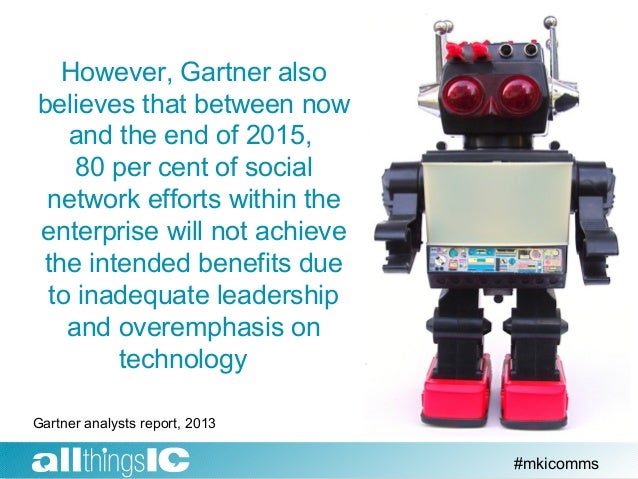
Of course, the first slide above is Gartner’s interpretation. But really? 80% in two-and-a-half years? That may well be true in the largest organisations or ones that are staffed largely by Millennials. But it most certainly won’t apply to the pick and pack barns I work with, or the leave-your-own-device-in-your-locker call centres; or even among the care workers who regard their phones as something to use voice to voice. We’re getting a little too carried away by the social wave – and I’m not sure enough people are holding it up to scrutiny.
To be fair to Rachel, she absolutely is – and was at pains in her talk to balance social media with other tools in our comms toolkit. She emphasised strongly that social is a state of mind – it’s fit for purpose for some, but not all, and should be dialled up and down depending on need.
She raised another point though that I don’t want to agree with. It’s about the changing role of comms professionals.

Okay. I’m still with those dinosaurs. I’ve gone through the stage where IC ‘owned’ comms. We were the creators, shapers, packagers, and postmen; measurers, reporters and crank-the-wheel-againers. Rachel suggests that time has passed. The role of IC pros now should be to manage the display to ensure it’s as effective as it can be. The new tools and channels are placing comms in the hands of everyone in the organisation, and our role is to ensure everyone has a voice.
I’m not so sure for two reasons. First, that rapid evolution hasn’t reached most businesses yet. Even the largest organisations I work with are still operating in an old paradigm. Take up of the new-comms mantle is patchy, and the demand for good creative content from the comms team remains strong. Second, the curatorial model could invoke anarchy. Could you apply it to other functions? Should we all do a bit of accountancy or a bit of IT. Shall we just use HR for a bit of window dressing while we do all our hiring and firing and people management team by team? I like the idea in principle, but IC must do more than curate. We still need to take the lead. As much as the accountants are the experts (and not to be messed with) in Finance, we have to be seen to be the experts in comms. Yes, it’s more about facilitating, enabling and coaching than packaging – but this is not the time to abdicate responsibility.
I’m wondering if some IC pros are leaping towards that abdication because they don’t actually have the solid grounding in content creation?
As Rachel said last Thursday night: “Content is king, Queen and Jack.” Sure, we can’t own it all and nor can any IC Pro be an expert across all content fields. But actually, some of the old-paradigm dinosaurs have that expertise in bucket loads.
Perhaps the holy grail is about breaking the false divide. Social should not be separate from traditional. Everyone in IC should be focused on enabling the right business outcome – the process of how you get there is important – but what matters most is asking the right questions in the first place.


 Posts
Posts

