Monday, July 01, 2013

The answer's social media - now what's the question?

Another cross-post from insideleapfrog.com

Last week I read a request for help on LinkedIn that so vexed me that I’m still thinking about it a week on.

A member of an IC interest group wrote: “I’m struggling to engage a specific group of employees who are reluctant to embrace social media any suggestions on some new innovative ways?”

My response was: “Do they have to embrace social media? It would seem that whatever the question is for IC pros at the moment, the answer is ‘social media’. Sometimes, in its many and various forms, it is the answer – but not always. 

"We seem to be losing the art of face to face communication and the appetite for traditional comms. In the rush to embrace the electronically-driven social world, that could be a very costly error. Have you talked to this group? What’s their take on comms? Are there channels and media that they appreciate and respect? What’s worked for them in the past – do you know the reasons why they’re not embracing social media?”

“Without knowing that side of the story, it’s tricky to suggest a way forward. But, the newest, sexiest, shiniest forms of comms aren’t always the best for any particular group, and the worst mistake we can make is to impose what we like onto a group with a different (and perhaps just as valuable) perspective.”

The debate has gathered almost two dozen comments, with a group suggesting various options to draw this non-specified audience into social media, while others have either supported me, or in the case of Jim Shaffer, moved the debate on a little. Jim’s point is that we shouldn’t be arguing about traditional v social, but, as he said: “The question and a lot of the responses here are about process versus results or outcomes. What results are you trying to change? What outcomes do you want from “embracing social media?” It would seem that if people 1) had access to a solution that would improve a business outcome, 2) if it was in their best interests to make the improvement and 3) it was their idea to adopt that solution, they would.  Or that’s what usually happens. Asking people to embrace social media is like asking them to embrace posters.”

For me, Jim’s hit on an issue that’s worrying me more and more as I engage with comms pros here in the UK. There’s a distinct band-waggoning on social with the result that any discussion of strategy or tactics that doesn’t involve the latest application of digital wizardry is kicked out the door in double-quick fashion. There’s an assumption that social is some kind of magic bullet – and that the likes of Jim or me advocating an approach that looks at audience needs, business outcomes and the best way for comms to enable such an outcome must be something akin to walking with dinosaurs.

It’s worrying to me in that we seem to be knocking back a good decade of internal comms evolution – the decade that took us from output to outcome and brought leaders across organisations out from behind their emails. To me, there’s a real danger that too much emphasis on social will push our leaders back behind their electronic walls – while too much emphasis on social media will over-dignify the technology, while underplaying the need for solid comms that brings people together in the right way to achieve the right outcomes. Too many people are getting a little too excited about the outputs again – without considering if they’re achieving the right results.

There’s so much talk of social media democratising business – but do you know what? Businesses aren’t democracies. And unless the principles of capitalism are about to fail, they’re not about to become democracies. I am immensely in favour of social’s ability to enable collaboration; to break down the barriers of geography and time zones. But it’s not a panacea. Surely it will enhance our communication offering, not replace all that has gone before?

Not according to Gartner, apparently. Last Thursday I headed up to Milton Keynes to listen to the very excellent Rachel Miller talking about ‘putting the social into communications’. In a really informative and entertaining presentation, she raised many points I agree with – and a few I’d take issue with.

Of course, the first slide above is Gartner’s interpretation. But really? 80% in two-and-a-half years? That may well be true in the largest organisations or ones that are staffed largely by Millennials. But it most certainly won’t apply to the pick and pack barns I work with, or the leave-your-own-device-in-your-locker call centres; or even among the care workers who regard their phones as something to use voice to voice.  We’re getting a little too carried away by the social wave – and I’m not sure enough people are holding it up to scrutiny.
To be fair to Rachel, she absolutely is – and was at pains in her talk to balance social media with other tools in our comms toolkit.  She emphasised strongly that social is a state of mind – it’s fit for purpose for some, but not all, and should be dialled up and down depending on need.
She raised another point though that I don’t want to agree with. It’s about the changing role of comms professionals.
   
Okay. I’m still with those dinosaurs. I’ve gone through the stage where IC ‘owned’ comms. We were the creators, shapers, packagers, and postmen; measurers, reporters and crank-the-wheel-againers. Rachel suggests that time has passed. The role of IC pros now should be to manage the display to ensure it’s as effective as it can be. The new tools and channels are placing comms in the hands of everyone in the organisation, and our role is to ensure everyone has a voice.
I’m not so sure for two reasons. First, that rapid evolution hasn’t reached most businesses yet. Even the largest organisations I work with are still operating in an old paradigm. Take up of the new-comms mantle is patchy, and the demand for good creative content from the comms team remains strong. Second, the curatorial model could invoke anarchy. Could you apply it to other functions?  Should we all do a bit of accountancy or a bit of IT. Shall we just use HR for a bit of window dressing while we do all our hiring and firing and people management team by team?  I like the idea in principle, but IC must do more than curate. We still need to take the lead. As much as the accountants are the experts (and not to be messed with) in Finance, we have to be seen to be the experts in comms. Yes, it’s more about facilitating, enabling and coaching than packaging – but this is not the time to abdicate responsibility.
I’m wondering if some IC pros are leaping towards that abdication because they don’t actually have the solid grounding in content creation?
As Rachel said last Thursday night: “Content is king, Queen and Jack.” Sure, we can’t own it all and nor can any IC Pro be an expert across all content fields. But actually, some of the old-paradigm dinosaurs have that expertise in bucket loads.
Perhaps the holy grail is about breaking the false divide. Social should not be separate from traditional. Everyone in IC should be focused on enabling the right business outcome – the process of how you get there is important – but what matters most is asking the right questions in the first place.

Friday, June 21, 2013

Don't chase the folly of the Emperor's New Clothes: make great content your communication King

Every day as I work, Twitter provides a back-beat to my activity. I’ll delve into YouTube for information I can use, and probably will check out Facebook and LinkedIn at least a couple of times a day. I’m a regular on the BBC News site, and a number of other sports, business and news sites that augment the daily paper I read and the radio that wakes me up - and also accompanies my transition from work to rest late in the day. A large chunk of my week is spent working on my own, but I never feel disconnected – my social set-up accompanies me through the day, wherever I happen to be working from.

I love the fact that we’re now so much more connected than in the past – whether it be purely socially or through the socialising of business communication. Every day my twitter feed is filled with the latest chat about instagram and its new video, the rise of infographics, the latest webinar, who has storified what and the best pinterest boards to check out. In fact, almost every day there appears to be a new application on the rise that could be fantastic for the businesses I work with. There’s a whole generation of social entrepreneurs out there evangelising. Some organisations are making fantastic strides in democratising the communication process and many, many stakeholders are joining in a rapid evolution of organisational communication – sweeping the old, top-down, elite-led communication paradigm away, and replacing it with a whole new era of connectivity, blurring the boundaries of work/non-work and enabling anyone who wants to be a collaborator, contributor and communicator across their organisation to assume that power.

Across a swathe of Gen-Y dominated organisations, often marketing-led and highly technology-attuned, we’re approaching communication anarchy. Not in a bad way of bombs and extremists, but in the sense of collectivism without rulers.

But then I come back to my working world: a world that in the last couple of months has seen me spending time with care workers employed by a charity (as far from the BBC reports of 15 minute care appointments as you’d possibly get); in a supply chain company’s ‘pick and pack’ operation; with sub-contracted engineers working for a power provider and in a small call centre that’s a very long way from the third largest operation in Swansea. None of the people I worked with was in a conventional office environment. In three out of four operations, people felt somewhat cut-off from their organisation’s leaders. All were proud of what they did, but few understood their contribution to the organisation or how they made a difference in achieving its aims. None in the three felt particularly part of any engagement revolution – not through an absence of tools and channels to get involved through, but much more so through a lack of high quality content that really connected with them. There was a consensus that their organisations were missing a trick: going all out to make the best use of technology, but not putting equal focus on the lifeblood of effective organisational communication: great content that’s timely, relevant, involving and delivers the right action.

At the call centre, staff leave their own devices in their locker. Throughout their shift, their machines display customer contact information, scripts and some very basic product information. There’s some social and admin material posted on noticeboards, and there are end-of-shift handovers where a little business information is shared – but people are, by then, very keen to get off the floor and away. It’s a hard-grind sales environment. staff turnover is high and loyalty is low. Managers and staff are rewarded on short-term sales goals – and the big picture plan is out of sight for all but the most senior. We’re now working on some simple information shared well. It’s not all about new tools – staff told us the last thing they wanted was company messaging popping up on their phones and tablets out of hours. So we’re bringing in some lunch and learns; regular team huddles; a suggestion and recognition process and much more management by walking about from a previously largely invisible senior team. At the most basic level, people want to know why they should get out of bed and what’s in it for them if they do. For the senior team, they want to know how they can keep their best people longest. In both cases, there’s a demand for up to date information, shared in a way relevant to the people involved. At this stage, it’s far from the technology-led, collaborative engagement revolution. It’s real back to basics stuff based on giving managers the confidence of a good story to share, and staff the confidence that responding and participating is actually worthwhile.

Elsewhere, my care workers, several of whom seem to manage at least two phones while serving lunches to the elderly and chatting to me with ease, want to know what’s going on in their organisation; some recognition for the extra miles they go for the people they care for; and the reassurance that the charity won’t be losing its care contracts. They exist in a vacuum, directed by weekly visit sheets that are updated by SMS. They’re low paid, almost exclusively female and generally older. But they’re open to technology – and every one I met had a smartphone. What they want is a regular channel that keeps them updated on their employer and makes them feel part of what, in the charity’s head office, is a crusade for great elderly care carried out with missionary zeal. Somehow, the link from the office to the care workers has been lost – the crumbs of communication shared are watered-down, late and poorly put together (all recognised by the charity’s trustees).

Meanwhile, my pickers and packers are much further along their journey. They’ve had three years of major change, and there’s no sense of the pace of change slowing. But they’ve been taken through every step of the change in a thoughtful, purposeful way. The change and comms manager showed me their business plan, the communications process that was helping to deliver the outcomes; the compelling narrative that provided the parameters for their communication; the stakeholder mapping that helped define who needed what, when and how; their feedback loops and speak up channels; their communication development interventions for anyone with a people management responsibility and the fairly simple, low-tech tools they’d used to involve people in the change.

In a very busy warehouse, I spent some time with a team who pick and pack components for airline engineering workshops. I asked a guy what he did: “I keep planes in the air,” he responded. For me, this was a breakthrough moment. His employer had got the content/technology balance right. This guy was connected to his company’s business aspirations and had made the connection between what he did and the benefit it brings to his end customer – a customer he never sees. But, in the breakout room, customer pictures and testimonials adorn the walls; infographics showing the supply chain stars get the narrative across quickly and effectively – and video case studies, updated monthly, detail different aspects of the business; its interaction with customers and how the products it supplies are used in aviation engineering. There was a real focus on telling great stories; using the company’s own people; and sharing just the right information (not all good news!) not just to inform the people who worked in a fairly soulless environment lifting and shifting components, but to really involve them in all aspects of the business.

The next day, I was out with a boiler engineer. Sub-contracted to a sub-contractor of one of the big six, he wasn’t actually sure at first which of the major players he was representing on our calls. He had a smart CRM device detailing calls, his schedule and enabling him to update each time he’d finished a job. But it had no other applications. About every half hour he was on the phone to ‘Dave in the office’ asking questions about obscure boiler parts, giving advice and bellyaching about his lodgings. While he was pleasant and polite with customers, there was no sense of representing his employer’s employer. He knew nothing about the power company and was unable to respond on at least two occasions when there was an open door to upsell to the customer. No-one had though to include my engineer in any kind of company communication. This was a failing of process, but also a failure to give him the right content not just to do the immediate job, but to represent effectively the company ultimately paying his wages. For him, better use of smart technology would help – but that better use has to be based on strong content that will engage his interest in the business he represents.
We can have connectivity a la mode until it comes out of our ears, but if it’s not backed with the right content, it’s worthless. As internal communicators, we can’t abandon our role in creating great content or helping others in our organisation to do so. And we mustn’t forget that while the fashion among evangelists is for newer, shinier, faster and flashier all the time, most of the workforces we represent aren’t Hoxton hipsters with the latest I-pad living their lives through apps, but are much more likely to be my Polish care worker with a passion for loud phone conversations while changing beds; my call centre mums, knackered at the end of an evening shift; my picker and packer fed up of the four warehouse walls, or my engineer, sat in his van, making another call to Dave.

We need to engage these people, and while the social media revolution may help us reach them more easily, we won’t grab and keep their interest – and provoke them into really giving their all – unless we can give them content that intrigues, inspires, educates and involves.

Wednesday, June 12, 2013

Cross-posting from insideleapfrog.com - The virtues of progressive pedantry

Does grammar matter? Does the way we adorn our language with spelling, punctuation, the right constructions and even, sometimes, standard vocabulary add to the clarity of our expression? Or does it just hinder the reader’s understanding of what we’re trying to say? The world has moved on a long way from the days when a government mandarin might write:

“This is offensive impertinence, up with which I will not put.”

Wrongly attributed to Churchill, it’s the kind of grammar pedantry that would not allow the writer to conclude a sentence with a preposition. Thankfully, the world has moved on. But, in much more recent times, I’ve noticed distinct slippage in the way we use grammar, punctuation and vocabulary. To some, that simply doesn’t matter. Oxford University’s Simon Horobin, speaking at the Hay Festival, asked grammar pedants to relax over such things as the use of the apostrophe; the spelling of words such as through (thru) and, more generally, the consistency of written English. He has a point. English is dynamic and ever changing. In fact, I’m rather surprised that he didn’t ask his audience to “chillax.” However, when it comes to business writing, the objective is to create a shared understanding, and you’ll only achieve that through consistency.

In the past couple of months, I’ve been bouncing between the usual round of client copy editing; assessing award entries, and marking undergraduate essays and dissertations. It has been illuminating in understanding just where we stand in grammar wars. From my perspective, written English is in a state of flux. There’s an age divide that seems to split those aged 35 and upwards from their younger peers, while we also have a divide between native speakers and those for whom English is a second (at least) written language.

Older writers are more structured, more formal in their use of grammar – but (huge generalisation) also more passive in their sentence construction and prone to 70 word + sentences. Late Gen Xers and the Ys and Zs following are consistent only in their inconsistency. They have a fleeting relationship with the rules of grammar, and such tools as apostrophes are sprinkled without rhyme or an awful lot of reason through their direct, active and often sparkling copy. They’ve slipped back, though, into the world of ‘amongst’, and ‘whilst’ for among and while. My students tells me it gives more gravitas to their copy. I simply repeat what my English Language tutor at Manchester University, Dr. David Denison, told me back in 1982: “It’s archaic, and a waste of ink.” That was 30+ years ago, but what was archaic then is creeping back now (and adds no gravitas!)

We’re far from txt spk taking over (another myth), but the business and essay writing of the young reflects a complete neglect of lessons around the process of written English in UK schools through the 90s and 00s.

And then there’s the rise of ‘International English’ – this new concept of English written for a global audience by non-native speakers that adopts the grammar rules of their native language. I’ll give you an example. I received some copy from a Dutch client that started: “Since today, we are rolling out a new way of working across the business.” I pointed out that this use of ‘Since’ was not something we’d say. In British English, ‘since’ always implies the past. My Dutch colleague simply didn’t get it – not entirely surprising as the construction is common in Dutch and German and used as we might use ‘from’. There are more and more examples of these internationalisms creeping in. Perhaps they’re a natural evolution, but the more crass intrusions should still be picked up with a view to helping the writer understand the nuances of British English.

Of course, the other battle is against that bastard son of American English, corporate babble. If I see another “leveraging the synergies” in my life, it will be several lifetimes too soon. Every organisation has its own language style, but the continual verbalising of nouns and use of meaningless phrases simply does the language no favours at all.

I used to think of myself as a grammar Nazi – but that has a distinctly pejorative tone. Today, I’m happier as a progressive pedant. Language – and our use of it – evolves. I’m comfortable about starting a sentence with ‘And’ and ending it with a preposition. I pepper my copy with contractions, the occasional elision – and the odd flourished dash.

And now I preach what I practice. Whether through my business grammar training module, through marking and grading undergraduate essays, or simply through editing client copy for publication, I’m striving for that balance that makes the written word clear, and technically as correct as it should be.
We can’t be stuffy about the development of language, but nor should we encourage creeping language anarchy. The goal has to be about creating understanding. For that, some simple rules, and their consistent implementation, is key.

Tuesday, June 11, 2013

Oi - I'm over there!

It's weird that my new blog has been up and running for quite a while now, but this one still seems to get the majority of the hits - I suppose, just because it has been around for quite a while.

Anyway, if you want to know what I'm up to in terms of internal comms and engagement, pop on over to insideleapfrog.

There's stuff on there on the training modules I'm currently offering, while I'm also working up a coaching piece specifically by those who are forced to communicate in business - but really don't want to.

So far, I've run it with a group of Finance and technology (and a combination of both) professionals - and it went down exceedingly well.

Tuesday, January 15, 2013

EC in EE 2013 - update

Responses to the 2013 EC in EE Survey are coming in steadily - though we're probably a shade down on the same stage in 2011. It would be great to get numbers up!

What's gratifying is the geographic spread - plenty from the UK/North America as expected, but new responders from continental Europe, New Zealand and most recently, India - surely set to be the next IC/EC powerhouse.

Some of what the early responders have to say is interesting - but perhaps pointing to employee engagement - and employee communications' role in it - not having moved very far in the last two years. Of course, more survey responses could change the picture entirely...

However, as of yesterday:

•40% of organisations still don’t have an engagement strategy, while
•over a quarter of organisations responding don’t differentiate between EC and EE.

HR ‘owns’ employee engagement in almost half the organisations responding so far, with the HR Director most likely to be responsible for managing the day to day engagement agenda.

•While intranets are all-pervasive, one in ten responders no longer use email as part of their communication mix in support of engagement.

• Almost three quarters of respondents are using social media in their comms mix, with blogs, yammer/chatter being the most popular tools.

•Twitter is coming up fast with over a quarter of respondents using it within their internal comms mix.

Early responders sees the key challenges for the next 12 months as two-fold: getting management buy-in to social media and more generally, having to do more with less.

Interested in contributing to the 2013 picture? You'll find the survey at https://www.surveymonkey.com/s/ecinee2013

Thursday, January 10, 2013

A cautionary tale of engagement

I'm still cross-posting but will stop doing so at the end of this month. So if you like what I write, please check out the new Leapfrog blog at insideleapfrog.com.

Meanwhile, here's a cautionary tale for those who perhaps don't pay enough attention to their 'net rep'.

However strong your brand; however motivated your people, your organisation’s reputation ultimately rests on the weakest link in the ambassadorial chain. A single employee bad-mouthing your business or your customers can stoke up a furore that can spiral well beyond any offence caused by the employee’s original action.

Such reputational time bombs are magnified hugely in an age where social media is fast becoming the prime feeding ground for traditional journalists who find themselves having to compete ever more vigorously for consumers’ interest in a news marketplace where you lose if you blink – never mind snooze.

Take the case of Holleh Nowrouz. Up until the end of December she was Sale Sharks Rugby Club’s social media executive. As such, her name appeared all over the club’s website; in its printed match programmes and, on behalf of the club, through a wealth of social media feeds.
Sale have recently moved from their Cheshire homeland to the new Salford City Stadium and their media team have gone into overdrive promoting the club to a potential new fanbase while trying to ensure the traditional supporters continue to follow the club at its new location. Their job clearly hasn’t been helped by the fact the Sharks are rock bottom of Rugby’s Premiership, with a revolving door on the coaches’ office and marquee signings not performing to anywhere near expectations.
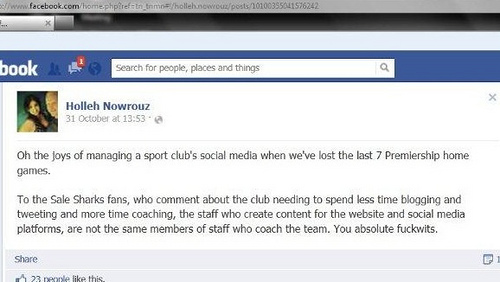
That said, it was hardly bright of Nowrouz to post the following status update on her personal Facebook page at the end of October:
Sale media furore

It’s a bit blurry (and sweary) but I hope you get the gist – Nowrouz vented her frustration on an element of supporters who seemingly weren’t differentiating the efforts of the media team from those of the coaching staff. By addressing Sale Sharks fans directly and expressing her opinion of some of them through a particularly poor choice of words, Nowrouz crossed an invisible boundary. Sure, this was posted on her personal Facebook page, but her name’s well-known, and any views she expressed through social media were bound to be linked to her role as a media spokesperson for her employer.
Had this been a ‘dear diary’ entry scribbled down before the age of Facebook, no-one would have been any the wiser, and Nowrouz would still be tweeting away on behalf of the Sale empire. But on December 21, the image above became rather more widely read in the public eye when it was posted on the Sharks’ unofficial fans forum . It was soon picked up across the network of rugby message boards and before the day’s end, had been picked up by the media. From the Mail Online through the Telegraph to Fox in Australia to the BBC, most stories shorthanded the issue focusing in on Nowrouz calling fans f*******.

Actually, before the end of the day on which her frustrated post was shared on the Sharks’ forum, very many fans were in agreement with what she said – but registered their recognition of her stupidity in how she chose to express her opinion. However, through their association with Nowrouz, Sale were taking a pummeling in the media. A club already seen to be close to crisis was now seemingly having its reputation trodden through the mud by the thoughtless actions of one of its own employees.

At first, the club sought to quell the furore (much of it based on Middle-England ‘righteous indignation’ rather than fact) by posting an apology:

Holleh Nowrouz deeply regrets the posting she made on her personal facebook page at the end of October. Disciplinary action has been taken and the matter has been dealt with internally and both Sale Sharks and Holleh Nowrouz would like to apologise to supporters of Sale Sharks for causing unnecessary distress.

Unfortunately for both parties, the story had gone viral by then with almost every commentator focusing on that last three word sentence. It took three days, but by December 24th, Nowrouz’s position was clearly untenable. She clearly regretted what she’d said and even more clearly had no intention of her words of frustration spreading around the world. But she’d made the cardinal error of committing private thoughts to a public space. One Facebook update, uncovered by a disgruntled fan trawling through her net rep had damaged brand-Sharks significantly – and more so, had provided an entry point for any media entity looking to have a dig at all the other travails afflicting the club. Two hours before close of business on Christmas Eve, the BBC reported:

Sale sack club official for Facebook comments about supporters
 
Sale Sharks have sacked their social media executive for posting derogatory comments about the club’s supporters on her Facebook page. Holleh Nowrouz was dismissed by Sale’s chief executive Steve Diamond following a “stringent disciplinary review”. Sale…are bottom of the Premiership table with one victory from 11 matches. “At this crucial time for the club Holleh’s comments, though private, just overstepped the mark,” said Diamond.

As social media executive, Nowrouz should have been more aware than just about anyone else at Sharks of the club’s social media policy and code of conduct for employees regarding talking about any aspect of the club through social media platforms. That’s if Sharks actually have such a policy – one suspects they certainly didn’t have before December 21st!

A core aspect of engaging employees has to be in helping them understand the benefit or damage they can do to their organisation through the way they talk about that organisation with their friends and family, suppliers and customers – and anyone who might be reading something they post on a social network. Clearly this is a two-way street. Employers should create and instill clear social media policies and pay extra special attention to anyone who’s seen as a spokesperson for the employer in the normal course of their job. Such people need special help and support to ensure they’re clear on where the boundaries lie. Equally, employers can’t expect to treat employees badly and steer clear of justifiable criticism. However, by working with staff to define and codify the boundaries, employers can steer clear of the kind of issue faced by Sale Sharks through Ms. Nowrouz’s action.

We all have to recognise that anyone in our organisation is a potential communicator and the tools of communication extend far beyond traditional corporate outreach and are now visible all over the world, all day, every day. Are you confident that you have the tools in place to ensure none of your employees, however inadvertently, does a Nowrouz on you?

Monday, January 07, 2013

Leapfrog's 2013 Employee Comms in Employee Engagement survey is now open

This is another cross-posting from insideleapfrog.com, my relatively new business blog. However, I still get traffic to this site, so it's worthwhile posting the information here too. However, the results/follow-up will be posted on insideleapfrog.com.

Two years ago I ran Leapfrog's first survey for Employee Communicators looking at their role in Employee Engagement. Now it's well nigh time to run the survey again to see what, if anything, has changed. So, if you're involved in employee communications, why not grab a coffee and fill in this year's survey.

The last survey drew responses from the UK, US, Canada, Australia and much of continental Europe. Can we spread the EC in EE word wider this time round?

The survey will run for the next two weeks and I'll publish the results before the end of the month.

The key findings from 2011 were:

Over 40% of respondents told us their organisation still had no engagement strategy

11% of respondents stated that Employee Communications was solely responsible for engagement in their organisation while a further 72.2% said they had a defined role in their engagement strategy/process and/or activities

More than a third of respondents' organisations really didn't see a difference between communication and engagement, while a further 25% were firmly on the fence

HR was still the primary owner of 'engagement' and the most popular home for the day-to-day management and delivery of the engagement agenda

Employee communications was playing a leading role as a contributor to the development of the engagement strategy in organisations

Just over half of all respondents considered their workforces to be relatively engaged (scoring 7+); but 36% stated their workforces remained largely disengaged with their employer

Electronic tools dominated the employee communicator's toolkit; with email and intranets virtually ubiquitous. Face to face communication was regarded as vital - but print appeared in decline

Social media was a planned part of the communication mix in more than 70% of respondents' organisations

The most effective employee communication tools in delivering the engagement agenda ranked as:

1. Face to face meetings (four times more popular than any other suggestion)
2. Communication Champions
3. Line managers
4. Intranet
5. Annual engagement survey

The top three factors that would make the greatest beneficial difference to the role of Employee Communication in organisations' employee engagement came out as:

1. A joined-up approach across functions
2. Effective line management support
3. Active buy-in from the CEO/Top Team

So, have we evolved in the past two years? Are we still locked in the world of email? Has print finally disappeared? Fill in the survey and make sure your voice is heard.

Thursday, December 06, 2012

Consulting on a project? Know when it's time to let go.

I've just published this on insideleapfrog.com But as there's still traffic coming through this site, I thought it was worth cross-posting here.

All good things must come to an end. As I write this, I’m printing out a final project report on something I’ve been involved in for the best part of two years now. Later today I’ll also make the call to end my paid relationship with a start-up that began in January. It’s time to move on from both pieces of work – but the parting in each case is actually quite emotional.

In the case of the start-up, it’s a simple decision to make. I’ve been on a very small retainer from the time a friendship group decided they may have a business idea through all the travails of setting up the business to the early months of its operation. Over the months I’ve been one of a number of sounding boards for them – occasionally taking a more active role as they’ve articulated their business plan and marketing plan within it. But now the business is up and running well. At this stage I have nothing of real value to bring to the operation. When it grows, I’d be delighted to get back on board, but at the moment, I’m a cost the founders can do without. It’s time for me to step back and watch this baby fly.

The other project is very different: a big corporate change programme in a division of a multi-national. I can well remember going to the first pre-planning meeting. ostensibly as a facilitator primed to ensure those attending filled all those blank pieces of paper stuck to the walls. Within weeks my role had changed from neutral facilitation to being part of the start-up team. Those 60-hour+ weeks flew by but we soon had a brilliant PM on board and a structure that ensured communication was an enabler working across all the activity streams – not an additional stream merely publicising decisions after the event. Engagement became the bedrock of the programme. The initial person leading this didn’t work out and I briefly stepped in to hold the fort. Our second engagement lead has been brilliant and much of my role has been as her back-up, coach and critical friend. But now the roll-out is complete. While there are a few months of sweep-up still to complete, the core project team is moving on. My time is done, and while this one will hit in the wallet, I want to go out with those involved thinking well of me.

I learned that lesson while working with Orange several years ago. After seven months of an intense project setting up a new b2b division, I sat down with the PM. The management team was in place. The nine countries involved were all on board; ways of working were nailed; we had our comms framework and activity plan and I’d helped them recruit a very able comms manager. For several weeks she’d been calling the shots, but I was still giving three days a week to the project. The PM asked me to carry out one simple task: to chart my perception of my cost v value. He did the same. For the first five months for both of us, value far outweighed cost – after two to three months my value to the project was at a real high. It had plateaued in months three to five, and then as the change settled down, I had it gradually tailing off. For the PM that tail off was much sharper and had reached a point for him where cost had overtaken value. I couldn’t argue with him: it was time to move on.

I had built an emotional attachment to the business and would have been happy to continue with them, but my client took a totally pragmatic view. While I offered something they couldn’t do internally, I was welcome and settling the monthly invoice was no problem. But when they’d built that capability in-house, there was no need for an outsider.

Now, on every project where I’m involved, I keep a mental chart of that cost v value – and when I feel the lines are going to cross, I know it’s time to ease away.

Monday, December 03, 2012

New monday Musing on insideleapfrog.com

My professional alter-ego has just blogged on insideleapfrog.com about the importance of alignment to engagement. Check it out here .

Friday, November 30, 2012

Time for a professional migration

Since I first started blogging in 2005, this site has been home for everything from my professional insights; gripes about the world of work and the ups and downs of running a microbusiness to bits about my family, my sporting interests, my academic sidelines and even my 15 minutes of fame as a TV quiz contestant.

That's not exactly a great deal of focus...

While I'm sure I'll continue to blog here, I'm moving my professional presence to my new site insideleapfrog. The idea behind insideleapfrog is to create a community site around organisational engagement, sharing insights and opinion and generally keeping a stronger work-focus than the occasional ramblings on here.

If you like the new site (or if you don't) please let me know. You can also follow my new business-related tweets at @leapfroginsider.